 BizAcquire
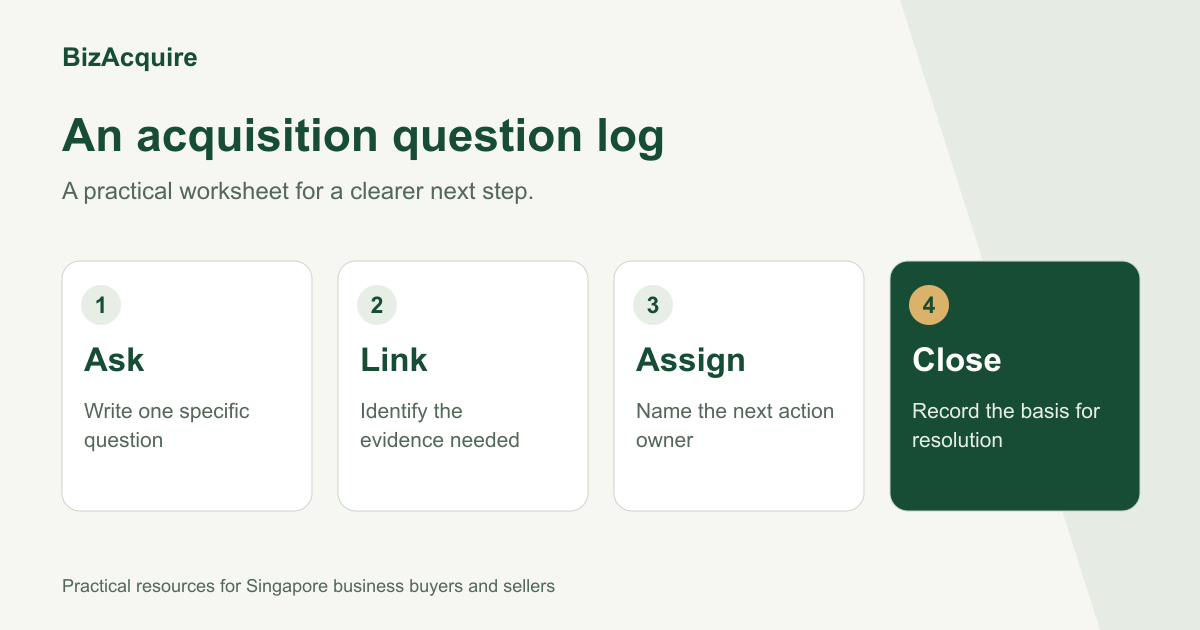
A long list of questions becomes difficult to use when nobody can tell which answer is current or who is checking it. An action log connects each question to the next piece of work.
Make each question answerable
Break broad requests into the decision they are meant to support. “Check the customers” is too vague. “Understand how dependent the operation is on a small number of customer relationships” gives the investigator a clearer purpose.
Avoid asking for every possible record before you know what the record would help establish. A focused question can reduce unnecessary sharing and make an incomplete answer easier to recognise.
Give the question a clear status
Separate a seller’s response from an independently checked conclusion. Useful statuses include open, clarification requested, evidence received, being checked and resolved. Add “not applicable” only when you can explain why.
If evidence conflicts, keep the question open and record the discrepancy. Do not let the presence of a file automatically turn the status into resolved.
Use the working log
| Field | Example of the kind of entry |
|---|---|
| Question | What do we need to understand? |
| Reason | Which decision does it affect? |
| Evidence reference | Document, explanation or observation |
| Next action | A specific check rather than “follow up” |
| Owner and date | Who agreed to do it and when |
| Status and conclusion | What is established and what remains unknown |
Fictional example: The seller describes a customer relationship as recurring. The action is to clarify the arrangement and what evidence can be examined. A spoken answer is recorded as a statement while the supporting check remains open.
Close questions with a traceable reason
When a question is resolved, note what was checked and how it answers the question. If the matter remains uncertain but the discussion continues, record that decision explicitly. A log cannot remove risk; it can make unresolved issues harder to overlook.
- Does every open item have an owner?
- Is the latest answer distinguishable from an older one?
- Can a reader find the supporting record?
- Does “resolved” explain the conclusion?
- Have new facts reopened an earlier question?
Use the document checklist to organise possible evidence and the evaluation guide to keep the wider decision in view.
Source and editorial notes
This checklist and worksheet are original practical guidance. No current legal, tax, accounting or regulatory requirement is stated here. Corrections or questions: contact BizAcquire.