 BizAcquire
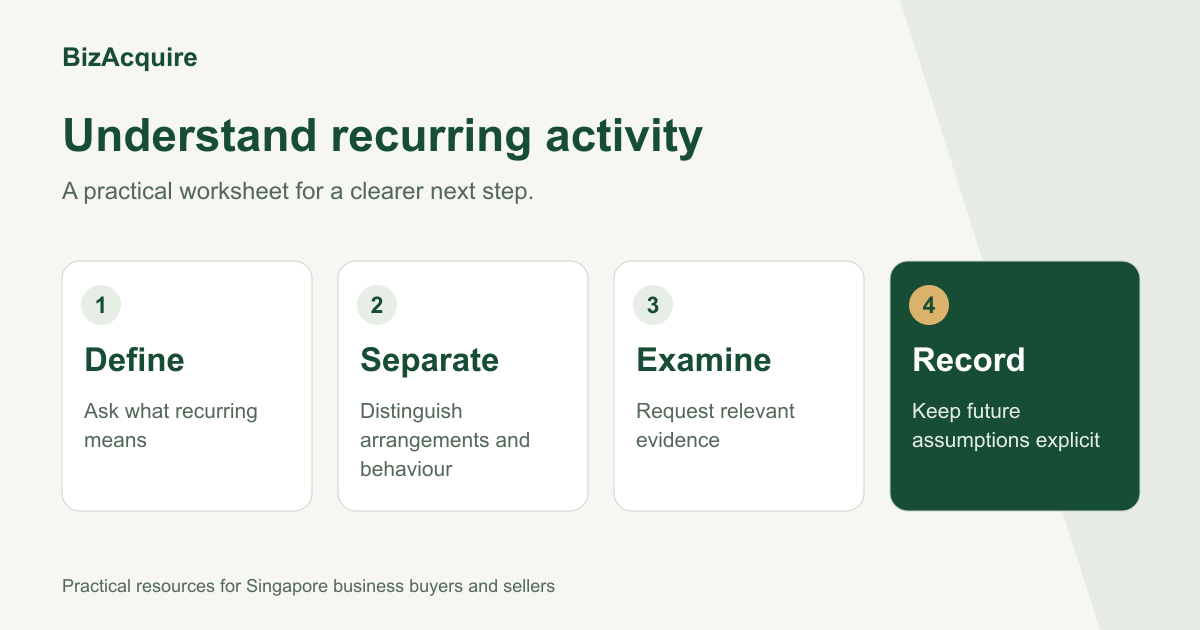
The word “recurring” can hide different operating patterns. A buyer needs to understand how work actually returns and what supports the seller’s description, rather than relying on the label alone.
Ask the seller to explain the label
A subscription, a continuing service arrangement and customers who repeatedly place separate orders can all create repeat activity, but they are not interchangeable descriptions. Ask how the business gets the next order and what would cause that pattern to change.
Avoid assuming that a repeat purchase establishes an obligation to buy again. Record the actual explanation and identify which documents or operating records might help you understand it later.
Discuss the operating pattern
- What does the customer agree to, if anything?
- Who initiates the next order or service?
- What period does the seller’s description cover?
- Are amounts stable or linked to changing usage?
- Who manages renewal, cancellation or follow-up?
- Which part of the explanation is based on past behaviour?
These questions are a way to organise the conversation. They do not determine the legal effect of an agreement or predict future revenue. Any contract interpretation needs an appropriate separate review.
Use a recurring-activity worksheet
| Field | What to record |
|---|---|
| Seller’s description | Exact meaning intended by “recurring” |
| Source of repeat activity | Arrangement, ordering behaviour or another pattern |
| Evidence period | Dates and records available |
| Operational responsibility | Who maintains the relationship or process |
| Uncertainty | What has not been established about future work |
Keep the same definition when comparing periods. If the business uses more than one pattern, show them separately rather than combining them into a single confident label.
Keep the next decision grounded in evidence
Fictional example: A business serves customers who reorder when their own projects arise. The seller describes these customers as recurring. The buyer records that work is repeat purchasing linked to customer projects and asks for a clearer period-based explanation. The label is clarified without making a forecast.
Do not turn the description into a valuation multiple or expected return without the appropriate wider analysis. Use the asking-price guide and evaluation guide to place this operating pattern alongside the rest of the evidence.
Source and editorial notes
This checklist and worksheet are original practical guidance. No current legal, tax, accounting or regulatory requirement is stated here. Corrections or questions: contact BizAcquire.