 BizAcquire
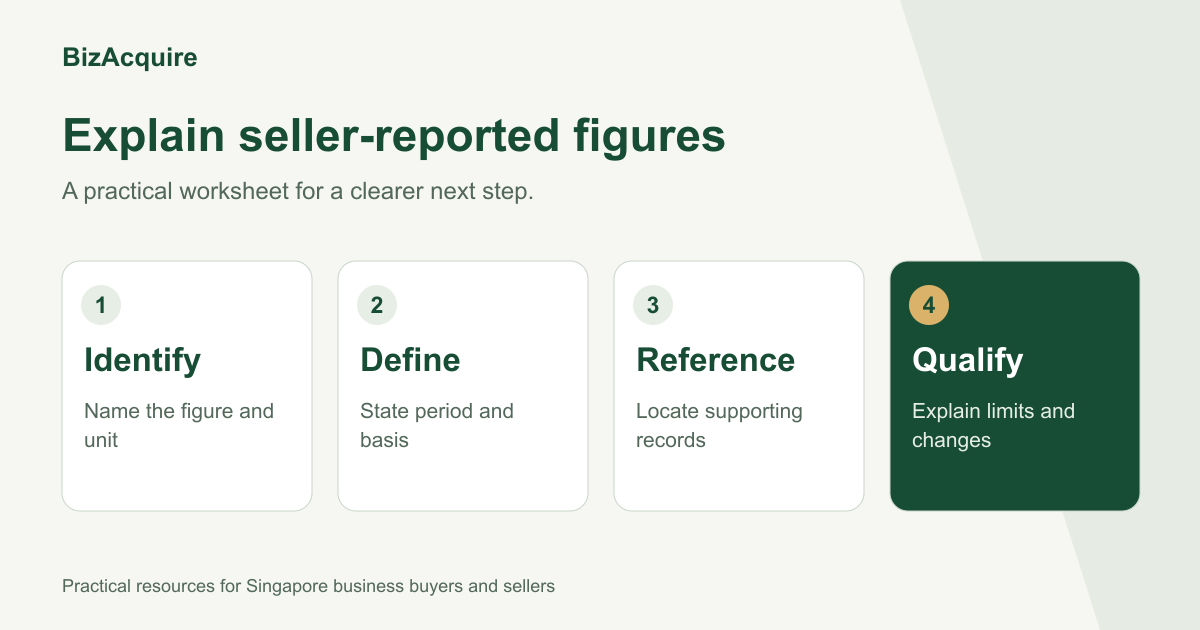
A clear basis note helps a reader understand what a figure is intended to describe. It also gives a seller a consistent way to explain estimates and unresolved questions without presenting them as checked facts.
Give each figure a complete label
Write the measure, currency or unit, and start and end dates together. A bare number copied between messages can lose its context quickly. If the number is an estimate, say that directly instead of allowing the reader to infer that it came from a completed report.
Use the same definition in the public summary and later discussion. Where a different measure is useful, explain the difference rather than silently changing the label.
Record the source without overstating it
Name the report or calculation used and note its version or preparation date. Referencing a report explains where a figure came from; it does not establish that somebody independently checked the report.
- Which record or calculation produced the number?
- Is the period complete?
- Are any assumptions or manual adjustments involved?
- Does the figure use the same basis as a comparison figure?
- Which questions remain unresolved?
Use a basis-note template
| Field | Entry to prepare |
|---|---|
| Measure and unit | What the number describes |
| Period | Start and end dates |
| Basis | Estimate, named report or calculation |
| Source reference | Where the supporting record can be found |
| Limitations | Missing context or unresolved adjustment |
| Version | When this explanation was last updated |
Keep supporting files in an appropriate private location. A public summary does not need to contain the underlying records or personal information that may appear in them.
Update explanations when the figures change
Fictional example: A seller initially provides a monthly estimate, then later receives a completed report. The seller issues a new basis note explaining the replacement and the period it covers. The earlier estimate is not silently rewritten as though it was always the reported result.
A transparent correction is more useful than a polished description that hides uncertainty. If you cannot explain a figure’s basis, hold it from the public summary and clarify it before relying on it in a discussion.
Use the document preparation checklist to organise source records and the asking-price guide to distinguish a discussion figure from a supported price assessment.
Source and editorial notes
This checklist and worksheet are original practical guidance. No current legal, tax, accounting or regulatory requirement is stated here. Corrections or questions: contact BizAcquire.