 BizAcquire
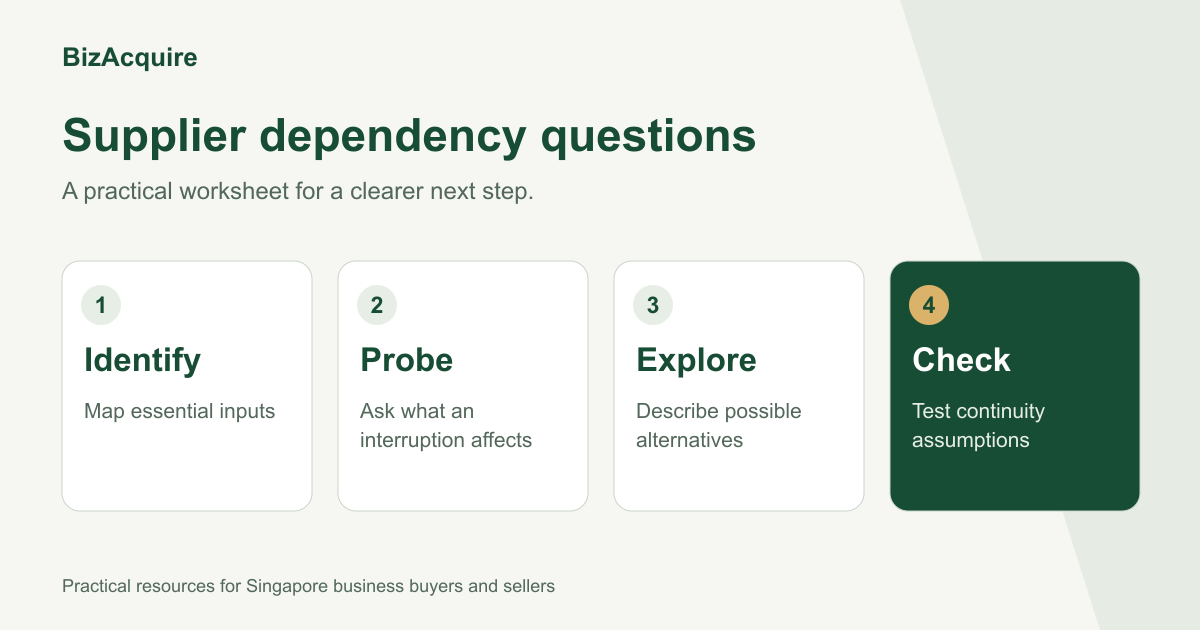
A supplier list says who the business buys from. A dependency map asks a more practical question: what would happen if a particular supply, service or arrangement changed?
Begin with essential operating inputs
List the goods, services, systems or specialist support the operation needs to deliver its ordinary work. A low-cost input can still matter if the operation cannot continue without it. Use the business’s actual workflow rather than ranking suppliers only by spending.
Discuss supplier roles without collecting unnecessary personal contact information. At the introductory stage, a functional description can be enough to identify the question that needs investigating.
Ask how the relationship works
Clarify ordering, delivery, support and any owner involvement. A relationship may depend on a particular product, a trading arrangement or knowledge held by one person. Do not assume continuity merely because the seller has used the supplier for years.
- What activity stops if the supply is interrupted?
- Who places orders and resolves exceptions?
- What stock or time buffer is described?
- Are terms or access arrangements documented?
- What needs checking before a buyer relies on continuity?
Use a dependency map
| Field | What to record |
|---|---|
| Input or service | What the operation needs |
| Operational effect | What an interruption would change |
| Relationship owner | Role managing the arrangement |
| Possible alternative | An option to investigate, not an assured replacement |
| Open check | Evidence or advice still needed |
A named alternative is only an option until somebody checks suitability, availability and the practical change involved. Avoid turning an untested backup idea into a claim that the dependency has been removed.
Choose a focused next check
Fictional example: A service business relies on a specialist supplier to complete one stage of each job. The buyer asks how scheduling and quality issues are handled and what would be needed to use another provider. This identifies a continuity question without inventing a cost saving or guaranteed alternative.
Carry material dependencies into the transition discussion and record who will investigate them. The handover checklist can help frame responsibilities, while the first-call worksheet helps keep an introductory conversation focused.
Source and editorial notes
This checklist and worksheet are original practical guidance. No current legal, tax, accounting or regulatory requirement is stated here. Corrections or questions: contact BizAcquire.