 BizAcquire
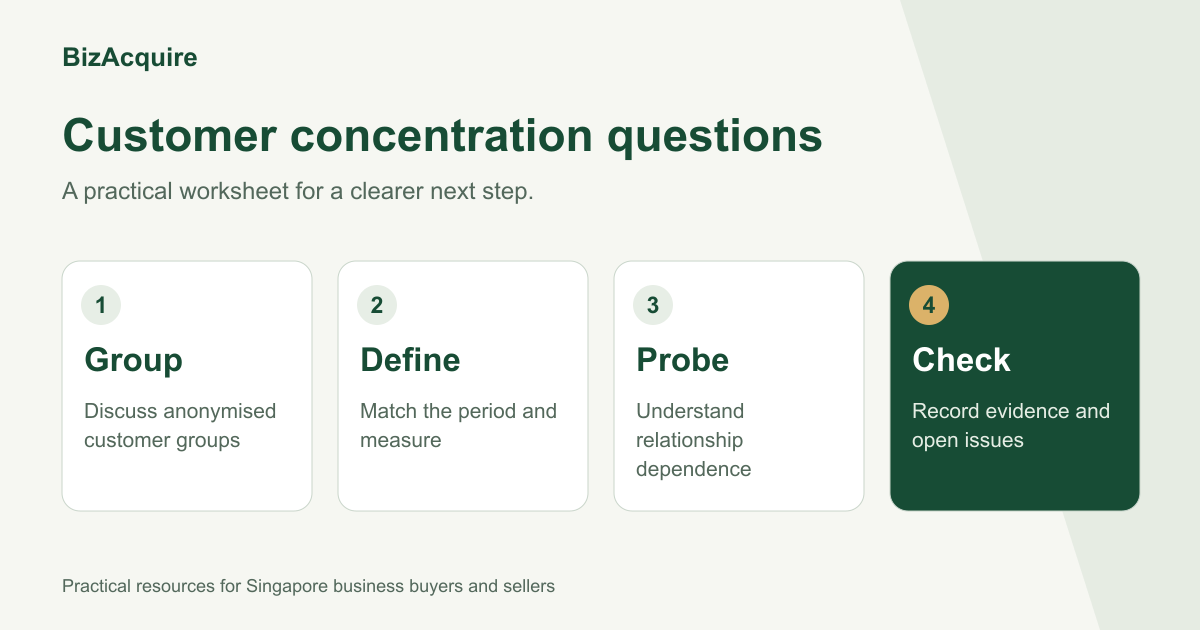
A business can serve many customers while relying heavily on a small part of its customer base. The useful early question is how dependent the operation is, not whether a buyer can collect a list of customer names.
Define what the comparison measures
Ask what “largest customer” means in the discussion: revenue, order frequency, amounts outstanding or another measure. Use a specified period. A customer important during one project may not represent the ordinary pattern of activity.
Request anonymised groupings where they can answer the introductory question. Labels such as Customer A and Customer B can support a discussion without naming the parties. A later evidence request should have a clear purpose and an appropriate sharing arrangement.
Explore the relationship behind the number
A concentration figure does not explain why a relationship might continue. Ask how work is won, who manages the customer and what could change the pattern. Keep the seller’s explanation separate from what has been verified.
- Is the activity repeat purchasing, a contract or a single project?
- Who handles the relationship and service problems?
- Is the owner personally central to winning work?
- What assumptions are being made about future orders?
- What evidence could support the description later?
Use an anonymised discussion worksheet
| Question | Record |
|---|---|
| Period and measure | Exact window and definition |
| Customer grouping | Anonymised label and explanation |
| Relationship owner | Role responsible for the work |
| Continuity assumption | What has not been established |
| Next check | Evidence, owner and follow-up |
Avoid treating an anticipated renewal as completed business. If the answer depends on another party’s future decision, record that dependency rather than replacing it with a confident forecast.
Keep the result proportionate
Fictional example: A seller explains that a large customer placed an unusually large project order. The buyer asks for a matching-period view and a clearer distinction between project work and ordinary repeat activity. No customer identity is needed to formulate that question.
The worksheet does not set a universal safe concentration threshold or calculate a discount to the asking price. It helps identify a dependency to investigate alongside the other operating facts. Use the evaluation guide and the first-call checklist to decide what to ask next.
Source and editorial notes
This checklist and worksheet are original practical guidance. No current legal, tax, accounting or regulatory requirement is stated here. Corrections or questions: contact BizAcquire.