 BizAcquire
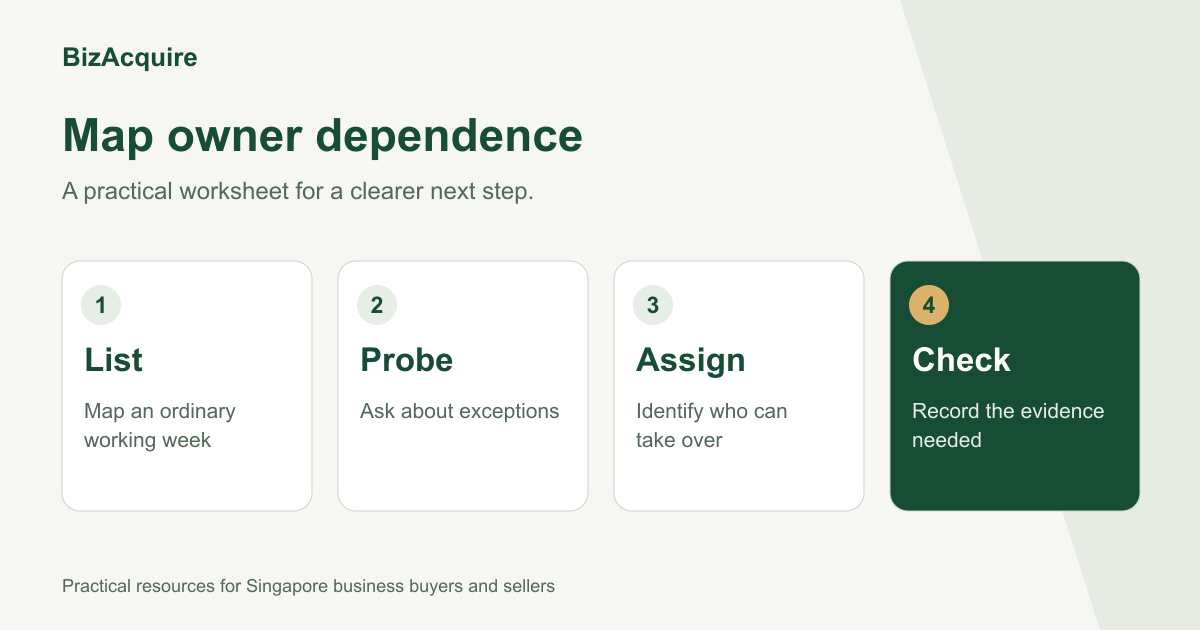
“The owner works part time” is a starting statement, not an operating plan. A task map makes the discussion more useful by separating routine work, decisions and problems that return to the owner.
List tasks rather than job titles
Ask the seller to describe an ordinary working week. Include customer enquiries, quotations, purchasing, scheduling, staff supervision, cash collection and quality checks where relevant. A title such as “manager” does not establish who carries the responsibility.
For each task, record the person who performs it, the frequency and the information they need. Distinguish work the owner chooses to do from work nobody else can currently do.
Ask what happens when the routine breaks
An operation can appear independent during normal trading while depending on the owner for difficult decisions. Ask for an explanation of how exceptions are handled without requesting private customer or employee details.
- Who responds when a customer disputes the work?
- Who approves an unusual purchase or price?
- Who covers an unexpected staffing gap?
- Who knows how to recover a failed system?
- Which decisions wait for the owner to return?
Build the replacement worksheet
| Task or decision | Current responsibility | Next question |
|---|---|---|
| Daily scheduling | Role, not personal details | Can another role manage changes? |
| Customer escalation | Who makes the decision? | Is the process documented? |
| Supplier negotiation | Who holds the relationship? | What must a buyer learn? |
| Technical exception | Who has the knowledge? | What training or support is needed? |
Do not automatically turn owner hours into a cost saving. A buyer may need to perform the work, hire somebody or redesign the process. The worksheet identifies a question; it does not calculate a valuation.
Connect the map to the next stage
Fictional example: A seller reports limited weekly involvement but personally approves every unusual quotation. The buyer records that approval task separately and asks what knowledge is needed to price those jobs. The useful issue is the decision process, not the reported number of hours alone.
Record what remains unverified and who will check it. Use the handover checklist to consider later responsibilities, and the first-call agenda to raise the most important dependency without overwhelming an introductory discussion.
Source and editorial notes
This checklist and worksheet are original practical guidance. No current legal, tax, accounting or regulatory requirement is stated here. Corrections or questions: contact BizAcquire.