 BizAcquire
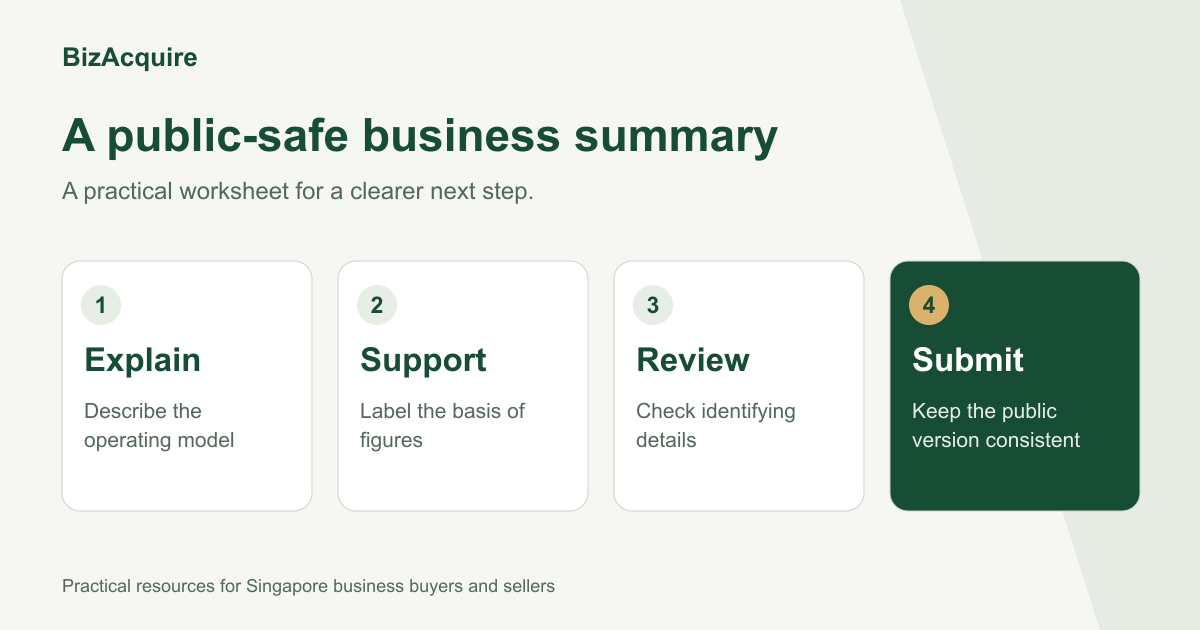
A public sale summary should help a reader understand the operating model and decide whether to ask a question. It should also reflect what you have deliberately chosen to disclose. Useful detail and careful editing can work together.
Explain the activity before the opportunity
Start with what the business does, who it serves in broad terms and how the work is delivered. A reader should understand the operation without needing a customer name or an exact address. Avoid opening with claims such as “guaranteed returns” or “a once-in-a-lifetime opportunity”.
Choose details that answer operating questions: the type of service, the work pattern, the owner’s role and the assets intended to be discussed. Do not add a capability simply because it is common in the industry.
Label statements that need context
A financial figure is easier to interpret when its period and basis are clear. Do not mix a recent strong month with a longer average or present a hoped-for improvement as established performance. Leave a figure out when you cannot explain what it means.
- Does each number have a period and definition?
- Is an estimate labelled as an estimate?
- Does the proposed sale scope match the description?
- Are growth ideas separated from actual results?
- Would I be able to explain the statement consistently on a call?
Review identifying details deliberately
Read the whole summary as an outsider would. A broad sector description may be non-identifying on its own, while an unusual location, customer detail and photograph together make the business easy to recognise. Decide what you are comfortable making public before submitting.
Check text, photographs, filenames and visible signs. Do not include passwords, bank details, customer records or employee identifiers. If you need advice about a particular disclosure, resolve that question separately rather than assuming the listing process settles it.
Use a before-and-after editing worksheet
| Draft issue | Better editing question |
|---|---|
| “Very profitable” | Which defined period and evidence support the figure? |
| “Runs itself” | Who actually manages ordinary work and exceptions? |
| “Huge potential” | Is this a proposed idea or demonstrated activity? |
| Identifying detail | Does a buyer need this in the public introduction? |
Fictional example: Replace “a famous café next to a named landmark” with an accurate broad description if that better matches your disclosure choice. Do not replace facts with invented strengths.
Read what publication review covers and the sale preparation document checklist. On BizAcquire, publication review concerns presentation, completeness and privacy; it is not a guarantee of the business’s performance.
Source and editorial notes
This checklist and worksheet are original practical guidance. No current legal, tax, accounting or regulatory requirement is stated here. Corrections or questions: contact BizAcquire.