 BizAcquire
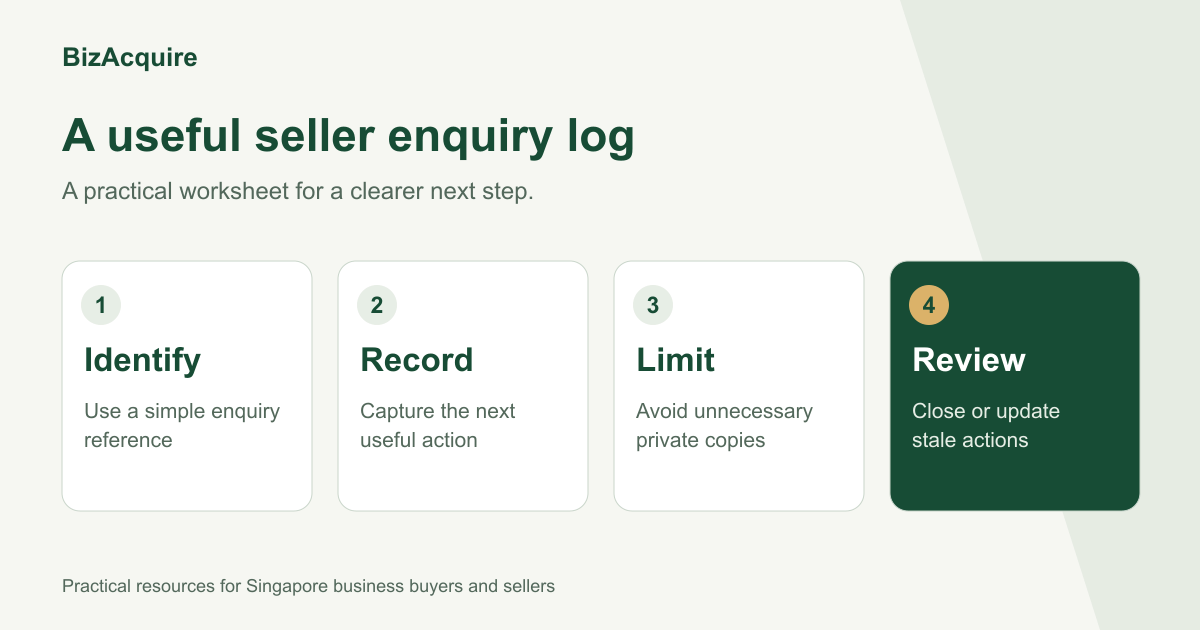
An enquiry log should help you remember what you agreed to do next. It does not need to become a second store of every message, personal detail and document shared during a possible sale.
Choose fields that support a decision
Use a reference you can connect to the original enquiry in your existing system. Record the discussion stage, the main open question, the next action and its owner. Add a follow-up date when both sides have agreed one.
Keep your observations factual. “Asked about training support” describes the conversation. “Definitely a funded buyer” makes a conclusion that a phone number or a polite call does not establish.
Use a small action log
| Field | Useful entry |
|---|---|
| Enquiry reference | A reference to the original record |
| Stage | New, contacted, awaiting reply or closed |
| Open question | The specific matter to clarify |
| Next action and owner | What happens next and who handles it |
| Follow-up | Agreed date or no date agreed |
| Outcome | Continue, pause or close with a factual reason |
Use neutral labels. A declined enquiry should not acquire an unnecessary speculative explanation about the person behind it. If a discussion stops, make the current position clear so somebody else does not restart it by mistake.
Avoid turning notes into a document archive
Where the original system already holds the permitted contact information, refer to it rather than copying it into multiple spreadsheets. Do not add account credentials, identity documents or private diligence files to a general follow-up log.
- Can this field be answered with a short action instead of a message transcript?
- Does access to this log fit the work somebody needs to do?
- Is a document link pointing to an appropriate private location?
- Does an old note need updating so it is not misleading?
Review the queue of actions regularly
Fictional example: A buyer asks whether the seller would discuss a transition period. The next action is “seller to clarify proposed training scope,” not “send all operating documents.” This makes the follow-up smaller and easier to complete.
On BizAcquire, a buyer may leave their number and the seller chooses whether to contact them. Use the published enquiry flow as your starting point. For the first substantive discussion, use the buyer–seller call worksheet. This log is an organisational suggestion, not a legal retention schedule.
Source and editorial notes
This checklist and worksheet are original practical guidance. No current legal, tax, accounting or regulatory requirement is stated here. Corrections or questions: contact BizAcquire.